Tuesday, 14 February 2023

Getting lost

 Summerlake Oregon

 When I was doing research for my middle grade novel, Red Fox Road, I drove down to a writers' retreat in a beautiful, windswept region known as the Oregon outback. There I spent two weeks in a cabin gazing out across a dry desert lake called a playa, and listening to the fierce wind attempt to tear the shingles from my cabin roof. Between periods of writing, I explored the lonely hills and caves that have been used by humans for fifteen thousand years. 

On my drive back home to Canada, I did what I always do on long trips, which I sometimes call writing while driving. I daydream. I compose sentences. I work out plot details. One issue was giving me a bit of trouble. Why did my characters take the shortcut that would lead to them getting stranded on a remote road in the Oregon wilderness?

I needed gas, so I pulled into a small town gas station. I went in the store and bought a bag of chips. Then I drove for about an hour, when I noticed a sign that said I was heading west. I was supposed to be heading north. In fact, I realized, I was not even on the same highway I thought I'd been on. I pulled out my paper map, which I luckily had, since there was no cell service, and I quickly realized my error. I hadn't noticed that the gas station in the small town I'd stopped at was at a crossroads, and when I'd driven out, I'd taken the wrong exit and started down the highway in a completely different direction. 

Checking my map, I noticed a skinny line that should take me back onto another road that would then connect with the highway I meant to be on. I considered the shortcut. Did it go through mountains? Could it be muddy or snowy or gravel? I had no idea. 

So I decided to spend the extra hour and backtrack to the gas station where I'd made my error. I didn't want to end up lost or stranded like the characters in my book. Frustrated with the waste of time, I cursed myself for daydreaming while driving. Until I realized that I had solved my problem of how my characters get stranded. I used my mistake to explain their detour in Red Fox Road.

How scary is too scary?

West Coast trail ladder

I'm reading a novel for middle grade readers that focuses on disasters caused by climate change. I like a good adventure novel, so I'm not usually put off by scary things happening in books. Worrying whether everything is going to turn out okay keeps me turning pages. Usually.

In my own writing, disaster and survival situations act as metaphors for the hard things we have to tackle in real life. I think I've always liked reading adventures and survival stories because they help me see that even extreme situations can be managed. My own problems pale in comparison to being lost at sea, for instance.

But there is a line for me in survival stories, especially those meant for kids. Reading this climate change novel, I felt like the author crossed that line at times. Dead bodies in burnt-out vehicles or floating in floodwaters -- it was kind of relentless. I wondered if it was necessary. Yes, it made for a page-turner, and I could see why the writer's books are best-sellers. But I began to lose interest, because it started to feel like I was being manipulated by the writer. And it seemed too hard to envision a way that the scary situations could be managed. I want a sense of control being regained, a sense of hope. 

I visited a few middle schools recently and asked kids what they thought about scary scenes in books. Only a few kids admitted to closing a book when it was too scary. Most said they liked it, including (maybe especially) the "jump-scare." What do you think?

Monday, 26 September 2022

Fiction and change


The west coast of British Columbia


In Buddhism, one of the fundamental teachings is that everything changes. That could sound, at first glance, like a self-evident truism that explains how trees lose their leaves in fall and the tide changes a shoreline as it ebbs and flows. But on another level, this idea can be terrifying. When I told my sister about this teaching, she said it scared her. I would say it scares me, too. For the most part, I like the way things are. I don't want them to change.

I was thinking about this in regards to storytelling. Fiction, too, we're told, is about change. But more specifically, it can be about a few responses to change: 

  • resistance to change: something happens that a character/characters struggle against (The Handmaid's Tale by Margaret Atwood)
  • desire for change: the character's situation is untenable and they seek to change it (A Complicated Kindness by Miriam Toews)
  • fear of change: the threat of change causes a character to react (The Road by Cormac McCarthy)
  • tumultuous change: the character is suddenly thrust into a new situation (Deliverance by James Dickey)
  • inability to change: a character is stymied by their rigidity (Remains of the Day by Kazuo Ishiguro)
 Some of these changes overlap and intertwine. And obviously, change isn't always negative. In fact, the happy ending is where the change turns out to be for the best. Or at least, the change is accepted in some way by the character. 

Wednesday, 17 August 2022

Adventurous or reckless?


Multi-day trip in Desolation Sound
A few years ago, I took a rappelling course from a local adventure company. The students were just me and one other person, a young guy. As we worked on our knots, the guide began a conversation about finding people you'd be comfortable climbing with, and also, being someone others would be comfortable climbing with. Then he asked the young man, whose name I've forgotten, but I'll call him Greg, to share a story about something that had happened to him recently. The story was that Greg had rented a kayak. Having never kayaked before in his life, he happily paddled out to the middle of Okanagan Lake. Like way out. Google tells me that Okanagan Lake is 120 kilometres long and between 3 and 5 kilometres wide. In other words, it's a big lake.  

All was going well until the wind changed. Then Greg found himself tired out from his paddling so far and unable to make any headway. As he floundered, getting nowhere, he admitted that he grew petrified with fear at the size of the waves breaking over his kayak bow. Eventually, his energy completely spent, he pulled out his cell phone and called the kayak rental company to come and get him. A guide had to kayak out and tow him back in to shore.

My sister, who I've shared many adventures with, says it's important to know what you don't know. For example, Greg could have found out that the bigger the body of water, the greater the potential for big waves, because of something called fetch, the distance over which wind travels across the water. He could have also found out that the wind can change on Okanagan Lake, and setting out with it gently blowing in one direction is no guarantee that it won't change before you return.

Also, I personally would not kayak alone out into the middle of a lake unless I had to, for example to cross it. The nicest part of kayaking, IMHO, is staying close to shore where you can see things like birds and other shorelife and where bigger boats can't travel. Some kayakers love the big waves and will travel out into the lake for fun, but they tend to do it in groups for safety. Also, it's important to consider your stamina and to avoid using it all up on the first leg of your journey. 

One thing I realized that day on the rappelling course as I heard the story is that I would not climb with a partner like Greg. Being adventurous is one thing. But being reckless is just a few skipped steps away.

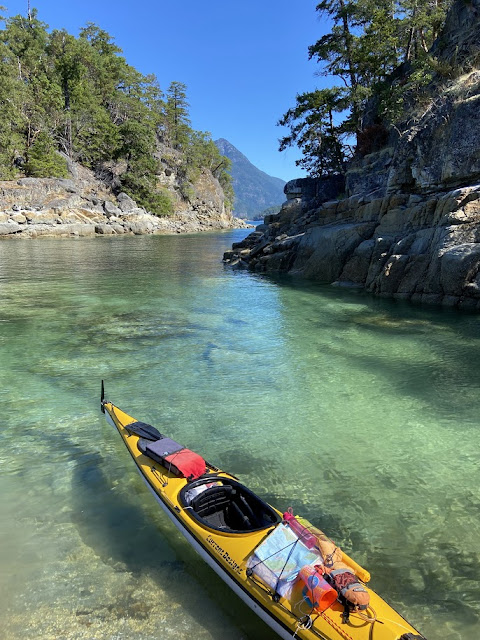
Another day, my friend and I were setting out to kayak, again on Okanagan Lake. We unloaded our boats from our vehicles and then carried our gear down and began strapping it to the hull. We each carry an extra paddle, a throw rope, a pump (to pump water out of the boat) and a paddle float. In the photo above, I'm also carrying a marine chart and a plastic cup to use as a bailer, because I discovered through practice that my arms tire pretty quickly using the pump to empty my boat. But those are items I add only for a longer, multi-day trip. 

While we were prepping our boats, a man stood by watching us. I noticed he had a slight grin on his face. When I met his eyes, he said, "You sure like to be prepared." His tone was gently mocking. I agreed that I did like to be prepared. He said "My friends I go out  paddleboarding in the Atlantic Ocean with just a cell phone for safety gear." The implication was we were wimps and he and his friends were not. I smiled and refrained from comment, but I was thinking that it sounded like the perfect opening for an adventure-gone-wrong movie. In the movie, the fit, cocky man out on the ocean on his paddleboard loses sight of his friends when the weather changes. He tries to call someone on his cellphone, but discovers he can't see the numbers through the fog on the plastic. So he tries to fish it out of its holder and he drops it into the (very) cold Atlantic Ocean. 

I don't want to leave my safety in someone else's hands. If I'm going on an adventure, I don't work Search and Rescue into my safety plan. That's a failed plan.

The paddleboarder's approach reminds me of something I've seen fairly often: a fear of looking stupid for being "over-prepared." Like people who don't wear helmets when riding or lifejackets when they're boating, some people seem to feel that taking steps to be prepared for things potentially going sideways is embarrassing. But which is really more embarrassing? To be the one who pulls out a mini air pump and a patch kit on a remote bike trail to help a stranger who gets a flat (as my spouse has done), or to be the one who makes someone else risk their own safety paddling out in high winds to tow them to shore?


Thursday, 2 June 2022

When I'm stuck


A rock and a hard place.
Some writing days, nothing much happens. I write a few sentences and scratch them out, get up and make a pot of tea, figure out a crossword clue, come back to the writing, write and cross out, write and cross out. If I have a string of days like this, I usually start to suspect that I'm going in the wrong direction.

Apparently, Warren Buffett has a box on his desk for investments that he considers "too hard." I use a similar filter for writing. If the writing is too hard, if a sentence or a plot isn't taking me somewhere, I back up and start again. But sometimes it takes me a while to notice.

When I was writing my second book, By the Secret Ladder: A Mother's Initiation, which is a memoir about the first year of new motherhood, I reached a point in the book where I was overcome with doubt. My editor had already warned me that expectant mothers might be scared by some of the story. I felt like if I told the truth, I'd be dooming the book to obscurity. But the dark part was the story. There was no way around that. I wrote, trying to ease into it, then I crossed it out. This went on for days. 

Finally, I realized that the path I was trying to take, softening the story, was too hard. And so I backed up and started again. Here's what I wrote:

Warning: This chapter is a little dark. If that bothers you, you could always skip it and go on to something with more light in it, more of what we associate with new mothers. You could choose to believe that becoming a mother is only about what you gain and never about loss. If you chose to believe that, you would have lots of company. 

I'm not supposed to be dark about this. I'm afraid of sounding ungrateful, afraid I've already screwed up my karma by unloading all my petty worries, and, as the books say, worry is bad for the baby. I worried about being worried.

After several days of unsatisfactory progress on my most recent novel, I realized that I'd set myself on a course I didn't want to follow. My characters were stuck in a cave (strangely metaphoric) and one person who is injured offers to give the other a boost to reach a potential exit overhead. But I discovered that I wasn't interested in writing that scene. This is how I got myself out of the corner I'd backed my writing self into:

A different stuck moment
"Let's try it," he said. "It's going to hurt but it's not going to kill me."

"Okay," I said. [Here's where I got stuck.]

But we didn't move. We sat there for another ten minutes or so while John Lee shifted, trying to get into a comfortable position, and groaned softly, trying not to. 

The conversation that followed did interest me and it got me back on a track where things are happening, the story is pulling me along. 

I pay attention to a physical feeling in my body when a story is deepening and beckoning to me. It's same kind of thrill I get from reading a good book. It's why I write.


Sunday, 13 December 2020

Low-tech: The long view

Snowy road near my house

As a reader, I'm sometimes jarred when I'm reading a novel and the technology the characters are using is slightly (or significantly) out of date. 

I confess that, in spite of having read several excellent novels lately with texting in them, I can't help feeling that five or so years from now, maybe fewer, that's going to seem quaint and a touch old-fashioned. 

It may be hard to believe that texting won't always be a thing, but once the telephone was seen that way. When I was a teenager, telephones -- the kind with dials, or maybe push-buttons if your family was a step ahead -- were the main way friends and I communicated. The fight for phone time in a crowded house, "party lines" where your neighbours could pick up the phone and listen in on your conversation, "extensions" in other rooms where your brother could pick up the phone and listen in on your conversation, that seemed like it was here to stay. So did record albums.

As a writer, I often face the question about what to do about technology in my novels. It's easy enough if I want the novel to be time-specific, like Shelter was -- set in the 1960s and 70s. But in Red Fox Road I wanted the time to be more or less now. That is, now, whenever now happens to be for the reader. That's why I go for the low-tech option, as much as possible. Unless it's important to the story, I want to keep the technology in the background.

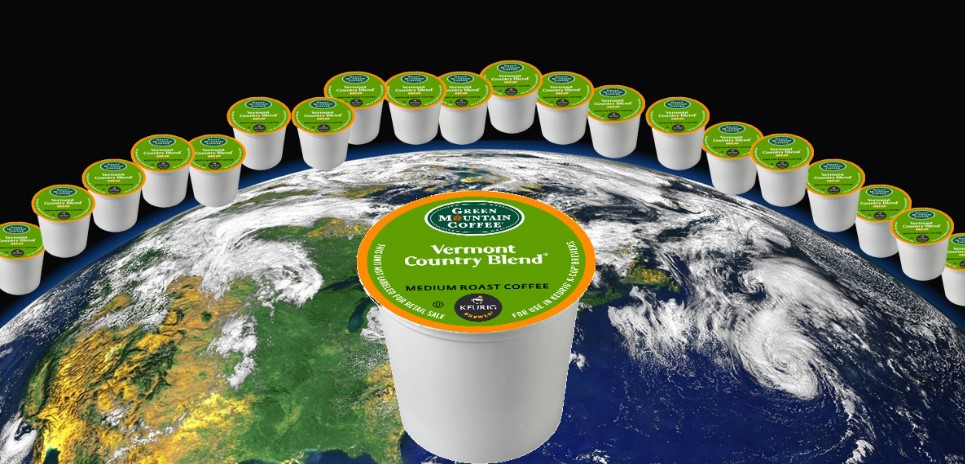
 The number of Keurig cups in landfills could circle the
 planet ten times. Don't get me started on tea K-cups!
Also, one of my themes in Red Fox Road and in the novel I'm working on now, Green Mountain Academy, is about the failure of technology. It's not that I'm anti-progress, or anti-innovation, quite the contrary. But I see, especially in the context of climate change, that we've used technology in many cases for cheap tricks, for junk that's literally messing up the planet. We could do so much better as humans. In Red Fox Road, Francie says "Not everything new that humans invent is better than the thing before it." Coincidentally, I agree with her! I think we need to be more responsible about how we use technology.

Getting out in nature, away from the noise of my various competing devices beeping, ringing, pinging and chastising me -- seeing the long view, literally, reminds me of how important it is.


Thursday, 5 November 2020

Don't side with yourself

Saturna island, BC

Stand firm. Don't back down. Stand up for what you believe in.  This was the kind of advice I heard when I was growing up. And to be sure, for a timid girl like me who was likely to back down whenever someone with a louder voice (which was just about anyone) spoke to me, it was helpful advice. I learned not to be a doormat and not to follow wherever someone else wanted to lead me.

But at some point -- maybe this point -- conviction and certainty begin to seem less useful than they once were. What would it be like to loosen my grip a little? 

"Don't side with yourself," said the 17th century Zen master, Bankei. I heard this expression the other day from Joseph Goldstein. It hit home. 

Maybe because the world is in a state of flux like I have never experienced in my lifetime. Maybe because the older I get, the closer I feel to the girl I was who found happiness sitting on a rock beside a little creek, counting the yellow leaves that drifted down from a cottonwood and landed softly on the water to be carried off gently down the stream. I didn't have to worry about being right or wrong. They are still my happiest moments.

I thought about the idea of not siding with myself this morning. Two days since the election in the US and the world is awash in side-taking. Opinions, fierce views -- what would it mean to let go, just a little, and see the other side? It's humbling to recognize how hard it is.
  

Saturday, 9 May 2020

A normal four a.m.

Full moon at 4 a.m.

Next weekend, BC is going to start relaxing isolation restrictions. We can gather in groups of six or less and maybe even hug each other. Or is that just family members in a closed group? I don't know. Meanwhile I have a fear that things are moving back to some kind of normal and I still haven't found what I'm looking for (to quote U2). Somehow I expected, if not enlightenment, at least illumination. Spring is here and the maple in the front yard is in lime green full leaf, casting shimmering patterns against brilliant blue. This morning I woke suddenly at 4 a.m. with a sense of urgency and I had to get out of bed and walk through the house, checking for -- what? That my son was where he should be, that everything was still where it should be. Everything was, except the full moon, which was shining in the pale early sky like it was still night. And I felt a longing to understand something, but that, too, was still where it's always been, just out of reach.

I'm not unhappy. I spend my days in the garden and feel very grateful to have these squares of dirt to dig and plant hopefully with beets and carrots and kale and arugula. Yesterday I transplanted tomatoes and bok choy and I took a ride on my bike and I felt like the day had been productive. Productive and relatively normal, but that's what feels wrong. Shouldn't it be extraordinary? Instead of washing my floors with a light solution of bleach and detergent while listening to Bruce Springsteen, shouldn't I be packing a few essentials and scaling a mountain I've never climbed to spend the night close to the stars and the moon and some kind of answers?

The experts say we'll have a "new normal," but in this new normal, will a dark-skinned man my son's age be able to run through his neighbourhood without fear? Will people in some of the richest countries in the world live in tents in a park in December and barter grocery cartloads of junk on sidewalks? Or will their new normal look suspiciously like the old normal? Will the most vulnerable among us still die before their time while others plan gardens and demand haircuts? Where is my part in this? I eat my avocado toast while hundreds of species continue to die out. Thousands sicken and some die so people can eat steak. Is this really the best new normal that the human race in the twenty-first century can manage? 

I cut tulips and sew face masks for my family. I believe I will come through this crisis relatively unscathed. I'm just not sure that's enough.

Monday, 4 May 2020

Isolation revelation

Saskatchewan prairie


I feel like there's a violin lodged in my ribcage.

My spouse has suggested it could be anxiety. Or maybe grief. Week six of The Covid isolation, as we've come to call this time, and he's sending me links to things to read about what I might be feeling. But none of these ring exactly true.

For a long time I've thought of myself as control-obsessed. I also know that I crave solitude. This morning, I realized how these two things go together. When I'm around other people, including and especially my beloved family members, I have an irresistible desire to meddle in their business. I'm going to blame this on being a writer, because it sounds better to suggest I'm driven by curiosity about the human condition than to admit that I'm just opinionated and bossy.

The Buddha said that "those who grasp after views and opinions wander about the world annoying people."  I first heard this from Jack Kornfield and I immediately identified with it. When I'm around others, I can't help but form opinions about the rightness or wrongness of their actions and their thinking, and to worry about it. Not only does this presumably annoy others, it sucks up the space in my soul where my peace and creativity reside. It is almost a physical occupation. I can feel it, like having too much caffeine -- a jumpiness of the heart, a jittery, fingers-in-too-many-pies feeling. And then I am overwhelmed by a desire to escape alone somewhere, preferably into the woods or down some lonely, windswept road. 

I think I now also understand why my spouse has always been so supportive of my retreats into solitude. It must also be exhausting for him that I, to put it nicely, care too much about what he's doing. Not exercising. Spending too much time at his computer. Not getting enough fresh air. Why can't I mind my own business? 

And yet when I do get away on my own, my ability to not care is profound. I care only about that birdsong that I always thought was a chickadee. Is it? The way the shadows fall in the afternoon. Where exactly the moon will rise. How long my tea has steeped.

Of course I only had this revelation this morning when my beloved and son left for Vancouver to empty son's apartment for month-end. The house is quiet and peaceful and the long, quiet day stretches before me. I feel the calm returning to my ribcage by slow degrees. I am resisting the urge to meddle in their business digitally. (When I began a text using the word "emptying", my phone helpfully supplied the word "soul" as the next word.)

I'm aware of how ungrateful this might sound, given that, around the world, people are suffering real loneliness in their isolation. But I can't be the only one having trouble coping with the opposite. Can I?

So I've decided to begin each morning with a simple vow: not to meddle in anyone's business today. My new mantra will be "It's your call." (I will try to mean it generously, with true goodwill and no hands-thrown-in-the-air undertones).  Wish me luck. This won't be easy for me.

Wednesday, 6 November 2019

Small steps

Climbing at Skaha Bluffs

Lately, whenever the weather is warm enough and the day ahead is free, I've been trekking into the rocky bluffs just outside of town with two or three friends. We take water, salty snacks, maybe some fruit and hot tea, and gear: ropes, carabiners, harnesses, shoes and helmets. The gear dangles from our backpacks as we hike in on one of the numerous trails that snake between the cliffs and crags.

It's beautiful to hike in here among the fragrant bent pines stretching into clear blue sky, to hear the tattoo of woodpeckers, and see hawks wheeling overhead. But we're not here to hike.

In the parking lot, we've pored over our climbing book and picked a rockface that the sun will warm throughout this crisp fall day.  We're beginners, so we've picked a couple of climbs that aren't too difficult, but offer us a bit of challenge.

At the crag, we rig up our climbing anchors and ropes, paying careful attention to the knots -- double fisherman's, figure eight, girth hitch. Our lives literally depend on getting these knots right. We dial in and focus. The outside world drops away. Dimly, I'm aware of carabiners clinking musically like bells on a donkey in a sleepy village. Sunshine and wind. The cool rock beneath my fingers.

Each time I begin to climb, stepping onto a tiny swell of rock that I'm going to call a foothold, running my fingers hopefully over the cliff to find something, anything, my fingers can cling to, a voice in my head says, "You can't do this."

My stomach roils a little and adrenaline quakes through my limbs. It is possible that the voice is right. I should have started climbing thirty years ago.  Not now, when I'm closer to 60 than 50. The thing is, it may have taken me this long to realize that in every beginning, there is the potential for failure. And failure isn't the end of the world. It's not even the end of the climb.

Every time my toe presses into an indent the size of a cashew, I take a chance at failure. When I choose a path for my climb, there's the chance I'll have to re-think my decision partway up the rockface when I can't find anything to hold onto.

I recently heard a climbing instructor tell a group of climbers to take small steps instead of looking for one big one. It's good advice, I found. I take a small step and the rock looks different. What seemed impossible suddenly becomes possible.

I'm learning how a small step can open up a bunch of new possibilities.


Monday, 8 July 2019

Is only trouble interesting?

Chilcotin mountain meadow

My students complain that I never teach any happy books. Last semester, totally by accident (are there any accidents?), I had a cannibalism theme going (The Odyssey, Cormac McCarthy's The Road, and a documentary film called Stranded: I've Come from a Plane that Crashed on the Mountains). I tell them that only trouble is interesting, or so, in various ways, say many writers with a dim view of human nature. For the most part, I've found this to be true. Only trouble is interesting. When everything is going smoothly in a book, I ask myself, when's the story going to begin?

But I recently read Heidi, and I thought, maybe this is the kind of book my students mean when they ask why I don't teach happy books. It's a delightful book; that's the word for it. And yet it starts with trouble and more trouble. Heidi is an orphan who is being deserted by her aunt -- left with her grandfather who lives alone on a mountain and has a reputation for being an ogre. Everyone in the village thinks it's cruel to leave her there and that the grandfather will have no idea how to care for a little motherless girl. The reader expects big trouble. But Heidi is so sunny and positive and curious and warm that she opens her grandfather's cold, closed heart and the two turn out to be kindred spirits who love nature and solitude. The book is heart-warming from the start and it's a gentle reminder that most people are essentially good, or at least mean well, and that the natural order of things is probably not to (The Road spoiler alert!) roast your newborn child on a spit over a fire. Most relationships have at the core some spark of tenderness and goodness, however clumsily expressed, and a book like Heidi captures that. I think that's what I love about good children's books. Not saccharine, they admit hardship, but they don't stop there.

Thursday, 3 January 2019

Slow writing

My 1975 notebook
When I was twelve years old, I wrote a novel called The Mystery of the Secret Passage. Much of it I wrote in our wartime house on a leafy Winnipeg street, where we had a crawlspace that was sun-warm in summer and furnace-duct warm in winter, smelled of old insulation and dust and had a small slatted vent where I could look out into our front yard and the sidewalk that ran past our house. I set up a makeshift desk with some boards, and in my memory, I sat on the floorboards and wrote. Having the desk made me feel like a real writer; it lent a certain commitment to what I was doing. I wrote the novel, suspiciously like a Nancy Drew novel, which I loved, in Hilroy exercise books. Word by word, sentence by sentence, I sank into the private world I was creating, not caring where the story was going or who might read it.


A page from Red Fox Road.
For my most recent novel,  Red Fox Road, I decided to allow myself this same luxury. I wanted to return to the simplicity and joy I found in writing when I was twelve. I wanted to close my ears to my own inner critic, and write something slowly, happily, word by word, just for the sheer fun of it. I had an idea that had captured my imagination: a girl on a family vacation becomes stranded alone in the wilderness when the family's GPS leads them astray. The idea was based very loosely on stories I'd read in the paper about mishaps with car's navigation systems. Also, my own little family had had a close call one day when we headed off on an off-road driving adventure, got lost, and couldn't retrace our steps because we didn't have enough gas.

I took out one of the notebooks I usually use for a journal, and began with the first sentence. It came easily and I didn't worry too much about whether it was the right sentence. It took me somewhere. And in writing this novel, I learned to pay attention to that feeling. Does this sentence take me somewhere? Is it where I want to go?

"In each act is the seed of the next." I'm not sure who to credit for that sentence; it's not my own, but it became my guiding principle. If the sentence I wrote took me somewhere I didn't want to go, I backed up, crossed it out, and wrote a different sentence. The wrong paths were usually ideas that I had imposed on the story, rising from some sense of obligation to include something. Apparently Warren Buffet has a tray on his desk labelled "too hard" and he puts ideas that he doesn't understand or has to work too hard at into that tray. My principle was similar. I wanted the story to roll along, to unravel like a road I was travelling down. I didn't want to impose too much of my vision on it in advance. I wanted to watch, almost listen for it. For me, the fun is in following the story, not having the story follow me. If I've set it up well enough, the story takes on a life of its own. It has its own intelligence, which is smarter than me.

In Journal of a Novel, John Steinbeck writes, "I sometimes feel that when I am writing I am very near to a kind of unconsciousness." I would say that about the way I wrote as a child, and I'd say that it's when writing is at its best for me now. I feel a physical change in my body when I find that, a sense of inhabiting the world I've created. I dream about it, it's the first place I find myself if I wake in the night. I can hear my narrator's voice, I watch what she does, what she feels and thinks.

Writing by hand seems to help me find that. Slowed down, I'm both more careful, and less constrained. Maybe the slower, physical act of handwriting, the pen drawing letters on a thick new loaf of paper, helps me pay more attention. And in writing this novel in notebooks, I remember the twelve-year-old girl that I was, on an adventure without a certain outcome, just for the joy of it.

Tuesday, 17 October 2017

Coyote jubilation


Photo by Gerald Romanchuk

Last night I was out in my yard digging in the garden around dusk when suddenly from the east, sounding very close, a band of coyotes sent up a wild howling, yipping, barking, crescendoing and decrescendoing. It went on for several minutes. My neighbour came out on her step to listen. "Crazy," she said. "They sound so close."
It was thrilling, a bit scary, carrying some primal, irrational sense of threat. When I heard the coyotes' frenzied voices, something rang in me, as it always does when I hear them, or see them loping down the road. The cry of jubilation, victory. Then I wondered if that was right. Maybe it was mourning. Wild grief, not jubilation at all. I have no way of knowing which it was. Probably neither.

How many times in my life have I misinterpreted what I've heard? One recent instance brought home to me how wrong I can be in my perceptions. I was camping at a lake I love, a place I'm comfortable going alone. It was a weekday morning; the campground was quiet. I was drinking my tea, listening to the wind that sometimes moves through the tops of the trees but doesn't touch the lower branches. A trailer pulled into the campsite next to me. We're separated by trees and a pretty good distance, but I'm not the most gregarious camper. I'm not quite on the level on Sartre with his "hell is other people," but I'm close. The way that my mind becomes hijacked by others' impressions, the stress of that processing, is the reason that I go camping alone in the first place. So I always have mixed feelings when others arrive.

After a while I heard a woman's voice come through the trees from their campsite. She carried on an unbroken stream of chatter. Once in a while I heard another voice interrupt. But then she went on. I tried to ignore it. Most people are more sociable than me, I realize. Clearly, she had something to get off her chest. But it started to irritate me. I went down to the lake. When I came back a couple of hours later, I was surprised to hear her still droning on and on. I wondered what she could have so much to talk about. I wondered why she didn't shut up for awhile and let me and the people around her enjoy the peace and quiet.

This went on all day long -- after I went kayaking and stood at the picnic table making my supper; as I built my campfire for the evening. Then the wind changed. I began to hear her voice much more clearly, and another voice, a young girl. I heard the woman say, "Maybe that's enough for today. I can read more tomorrow. We'll be able to start on the other book. Did you bring it?" And I realized that what I'd been irritated by all day long was the sound of a woman reading to her granddaughter.

I doubt I'm the only one who has spent years, literally years, rehashing things that have incredible power over me, the power to make me blush, or the power to make my vision blur, my heart thunder in shame. Shame seems to be one of my most stubborn emotions. But I'm beginning to realize, at the age of fifty-six, that it's just possible that these things I've perceived in certain ways are wrong, that I got them wrong at the time and that I've continued to feed the flames of my wrong perceptions every time I call up the memories. My perceptions are not reality. That's what I'm learning.

The Urban Coyote Project says that coyotes have more than eleven vocalizations whose meanings are complex. One coyote can sound like many more, because of the way they change the pitch. Normally, I don't spend a lot of time wondering what the sound means. I appreciate the mystery. I would like to be able to bring that spirit to my more mundane experiences, too.

This is a beautiful short recording of coyote voices by Rocky Raybell on the Colville Indian Reservation, in Washington State. He calls it Coyote Symphony.


Tuesday, 1 August 2017

The Road Past Libau part II

Mary, my grandma, Neil and me
with pump and bunkhouse in background, early 70s

When we were near the turn that my sister, Mary, and I thought was the road to our old farm, I phoned my brother Neil on my cell phone and asked him to guide us. His memory for the navigational details was better than mine or Mary's. That sounds like it, he said. Turn left. So I'm almost sure we'd found the right place. The road seemed exactly true to my memory; I remembered how when we walked in, there was a sense of mystery about what lay beyond the bend.

But when we drove onto the property where our house and barn and outbuildings had been, everything seemed out of place. Some things were familiar: the thick woods, the soft powdery soil, even the sky, a scrubbed clean blue. But it was as if the rest of it had been bulldozed away. How many years had it been? Forty, we realized with shock. How much could change in forty years? How much could we have remembered wrong?

The road at the curve.
Mary and I remember painting the bunkhouse one weekend. We leaned the ladder up on one side of the bunkhouse and climbed onto the roof to paint the trim. It was morning, coolish. By noon the sun was high, and the side of the roof with the ladder was too hot to walk on. The other side was too far down to jump. We were stranded up there.

We looked for that bunkhouse. There were buildings like it, but none had the attic trapdoor in exactly the same place, the door we'd unhooked so that we could swing down off the roof and lower ourselves to the ground.

You begin to wonder if it's the actual place that's wrong, or the memory of it. How many times have I told an old familiar family story, only to have one of my sisters, or my brother, say, "That wasn't you, that was me." The place now, the farm, the outbuildings and the way it felt at night when the quiet was so deep my own heart beating was the loudest thing in my ears, have taken on new shapes in my memory, as they've become the setting for my new novel, The Burned House (originally Sing a Worried Song).

Saturday, 7 January 2017

Coffee Italian style

Coffee machine in a gas station on the way to Marco Polo airport

Although I'm not normally a coffee drinker, I've been longing for the caffe macchiato I had in Italy. I recently read an article about why we should start drinking coffee like Italians do. Instead of filling 16 or 20 ounce paper cups, carting them out to our cars or bus stops or shopping malls or desks and sucking on them mindlessly for half an hour, the article suggests North Americans try drinking coffee Italian-style: from a small white ceramic cup, standing up at a counter and downed in a few quick sips. While at first glance, it might seem like the ritual of this quick hit of coffee is a bit like swallowing a couple of aspirin, I've come to believe that it actually results in much more of a break than the North American style Starbucks march (or the Canadian Tim Hortons drive-through routine.)

When I was drinking coffee in Italy, I stood at a usually crowded counter with my tiny, perfectly brewed caffe macchiato (which I learned means "stained coffee," which is why in Italy I was told to make sure I said caffe first, not just "macchiato") and I drank coffee. I didn't check my email or negotiate traffic, walk down the street or teach a class, or anything else, really, except maybe to exchange a few words with the person I was standing with. Drinking the creamy, smooth, laced with slight bitterness coffee gave me this precious inward moment. Then I moved on. The day went on. But during my brief time in Italy, I looked forward to having that moment each afternoon.

When we were leaving Italy, our hosts stopped at a gas station on the way to the airport to get a coffee. Used to gas station coffee in North America, a watery brown and tasteless liquid warmed in a plastic carafe and dispensed into a styrofoam cup, then stirred with a plastic stick, I was surprised to see the gleaming espresso machine behind the counter, kept running by beleaguered baristas in uniforms who shoved the little ceramic cups across the counter to people in a hurry, like in gas stations everywhere. They did have disposal cups in this gas station. Because we were on the way to the airport, I took my caffe macchiato to go.

I realized my mistake immediately. First of all, I was embarrassed by how pointless and wasteful it was to take a paper cup to drink a coffee that would be gone in about three sips. But also, the moment I'd had standing and savouring my little coffee was missing.

From https://oliveonblonde.wordpress.com/tag/plastic/
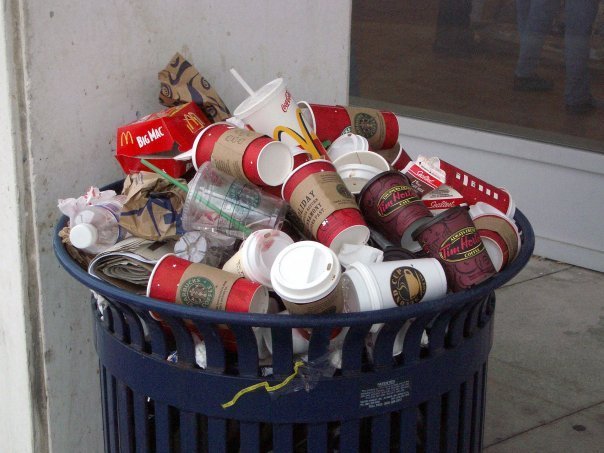
Somehow the waste of the paper cup and the waste of the experience are linked in my mind. Why are we North Americans so good at taking a good thing and "improving" it to the point of ruining it? Why do we take a three or four ounce cup and turn it into twenty? And why do we always seem to lead the way in wastefulness? In Italy, I never saw the overflowing garbage bins outside of cafes that are such a common daily sight in communities across Canada and the US. An event like the Festivaletteratura that I was part of in Mantua didn't result, as it would in Canada, in streams of barely used, discarded paper and plastic food containers trailing down the sidewalks.

You might think that borrowing this Italian idea of coffee drinking, and at the same time eliminating mountains of waste, would be a no-brainer. Sadly, instead, there's a new ban on bans in Michigan, prohibiting local governments from banning or regulating the use of plastic containers.


Thursday, 22 December 2016

Understory

Skagit River Trail, Manning Park, BC

Yesterday, I drove up the Green Lake Road to go cross-country skiing. I was also looking for cedar boughs, which smell like nothing else, and which have a special meaning for my husband, David, and me. When we lived in the Fraser Valley, we were surrounded by a lush forest of cedars. Their fronds look like feathers, and when it rained, we'd step outside and be enshrouded with their rich, tangy fragrance. We also took part in sweat lodge ceremonies where cedar was used. So the scent alone is healing to me.

The cedar I see growing in a damp area near the creek here is probably Western redcedar, which grows in the interior. As I drove along Green Lake Road, I noticed spruce and fir and the beautiful orangey-barked Ponderosa pine that scents the woods in this part of the Okanagan.

What's so important about naming these trees? When Shelter came out, a few people commented on Maggie's obsession with naming plants. I obviously share that obsession. I want to be able to tell the difference between a spruce and a fir.

Okanagan pines

Just like I learn the names of people, I learn the names of trees so that they're familiar to me. I recognize their faces: the deep-fissured bark of the Douglas fir and the stringy bark of the cedar.

I like the word understory. I know it means the layers of growth in a forest, but I like the idea of it being a story in the sense of a narrative. If I know the names of the trees and other plants, I understand something about the story of the forest I'm in. The ability to read a little of that story seems important to me.

In the pine forests around here I can find oregon grape, wild roses, saskatoon berries, kinnikinnick, and yellow balsam root in the spring. In the coastal cedar forests, I'll find huckleberries, salmonberries, ferns, devil's club.  I can eat the berries and avoid the devil's club, though if I knew devil's club better, I'd appreciate its many uses, too.


Saturday, 29 October 2016

West Coast trail: one step in front of the other

Boardwalk on the Westcoast trail

When I wake up in the middle of night and can't get back to sleep, I lie listening to the owls calling from the tall pines down the street from our house. I read that the call of the great-horned owl has been "translated" in our language to "Are you still up? Me too." That middle of the night, nameless anxiety that I feel is both echoed and soothed by their voices, resonating into the darkness.

I think it's not uncommon for regrets to come thundering in on us in the dead of the night, when no one is there to distract from the memories. This is partly the subject of the novel I'm working on, called The Burned House. My regrets, I believe, are relatively minor in the scheme of things, but they loom large at the witching hour of 4 a.m. Lately I have distracted myself with a kind of meditation that I discovered out on the West Coast trail, on the westernmost edge of Canada, where the Pacific Ocean crashes into shore on the wrecks of ships long abandoned to the sand and wind.

I carried a thirty pound pack, nearly a third of my weight but as light as I could make it without going hungry or cold. I had practiced hiking with this pack, but only loaded to twenty pounds, and I worried, when we stepped onto the trail, and within fifty feet encountered two sets of ladders with moss-covered rungs leading pretty much vertically up a rock face. I worried about whether I'd be able to make it, or if I'd have to suffer the ignominy of being rescued by helicopter and air-lifted off the trail. Or worse, of course.

We had been warned, frequently, by websites, handbooks, park guides, and bus drivers, that mishaps on the trail were frequent, up 300% this year for some reason. I was hiking with my husband and my sister and we were all fit hikers, but we had mostly done canoe camping. We were not used to carrying so much weight on our backs.

The West Coast trail is incredibly beautiful, traversing old growth forests with huge ferns, firs, cedars, and waterfalls. Just breathing the air feels healing. Sunlight streamed through the trees, and landed on our faces and for a time, the other world, the one where we have jobs and buy dish soap and get our oil changed, was gone. It was one careful step in front of the other. Then we were hungry and shrugged off our packs and ate the things we'd carefully packed -- almonds and licorice and rice cakes. Then coffee. Can anything be as healing as drinking a cup of hot coffee sitting on smooth grey driftwood three feet in diameter at the edge of the Pacific Ocean with forests older than human memory at our backs?

At night when I can't sleep, I come back to that place, the certainty of its constant change, the thunder of surf on sand, the rich odour of soil and trees, decay and renewal. I feel the weight of the pack, but nothing else, as I put one foot in front of the other, covering the miles.

Saturday, 28 May 2016

Look up

Okanagan hills

I'm not a person with a grudge against technology, but I've been thinking how social media, in my case, specifically Facebook, has caused my experiences to have this odd third person feeling. I already tended that way, since I'm a writer and I'm constantly processing and shaping my experiences into stories. Now the phenomenon is even worse. I stand outside myself, sometimes at my most private moments, watching. I'm present, but I'm also conscious of the moment as precious and worthy of sharing.

The other day I was in the scrub pines on a dry hillside up a backroad near here. I was looking for some pine poles to build a gate (to keep the deer out of my garden). I had my head down, scouting the ground. I'd pick up a length of pine and test its strength by cracking it over a rock. Some beautiful twisted lengths flew to pieces, rotten already. So I kept looking. They had to be longer than 6 feet and preferably with a lovely bend or twist. The relentless sun and wind on that east side of the valley makes curved sculptures of the pine boughs. I was absorbed in that, eyes on the ground, watching my feet, stepping over little piles of scoured clean deer bones (I think) and I turned to see where I'd left the poles I'd found so far.

It was almost by accident that I looked up and the view slammed into my field of vision. An incredible sweeping 180 degree panorama of mountain after mountain after mountain in shades from deep navy to sky blue to white where the snow was caught, and then the sky as many shades of blue above that. It took my breath away. It made me smile. I had that moment all to myself -- awe, gratitude. I took a few steps back at my task, then I stopped and fished my phone out of my pocket.

Already I was processing it. The moment had passed. I couldn't quite find the same view in my phone camera frame as what I'd seen when I first looked up. Even now as I'm writing this I'm tempted to Google what I'm grappling with. I'm trying to think of the search terms I'd use to see if someone else has already thought this out, and better than I could. Then I think, wait, I'm allowed to have this insight and think it is original. I'm allowed to ponder it slowly and deeply myself, exploring my own messy questions and revelations instead of boarding that wearying Google train lurching from idea to idea to idea until I've lost the curiosity that made me wonder in the first place.

To leave the phone behind is the obvious solution. But that would mean a consciousness about the potential for these random moments of beauty that seems contradictory. I was just out to find some sticks. I told David I'd be back in half an hour. I brought my phone along partly for safety. I did mention the picked-clean bones?

I'm learning to meditate. I'm an absolute beginner and there is so much I can't get my head around. But I think I have an inkling about what it means to be present, attentive to what is. The problem is in the hyper-consciousness of experience, processing it, a word I associate with processed meats -- same de-naturing. Once I begin to process it, break it down, add to it, I'm no longer just there, experiencing the richness and complexity. I'm assessing and judging. And this is a loss.

"One seeks and seeks but cannot find. One then gives up and the answer comes by itself." Alan Watts.

Thursday, 21 January 2016

The road past Libau Part I


This summer, while researching details of the setting for Sing a Worried Song, my novel-still-yes-still-in-progress, I went to rural Manitoba looking for a farm where I'd spent many peaceful weekends in the 1970s. My family owned the farm, bought it for next to nothing: 80 acres, (half a quarter section) of sandy land riddled with rocks over most of it, except the part that was swamp. The thing is, over the years we'd heard that the house, barn and outbuildings had been razed. On several occasions, on the way to somewhere else, I'd looked for it, but never been able to locate it.

Us, in the early 1970s.
This year I took a few days to visit my sister Mary at her cottage, which is about an hour's drive past where the farm was located. We were determined to find the site of the old farm. She had looked for it too, now and then over the years. It's strange to lose a place, especially one you've loved.

My mother used to drive us out there and drop us off to spend the weekend, or sometimes a whole week, while she went back to the city to work (Winnipeg is about an hour away). It was the early 70s. I remember walking barefoot the five miles to town, the fine sand of the road as soft as baby powder between our toes. When we reached the highway, we had to put our runners back on so we wouldn't burn our feet on the tarmac. What did we buy at the store? Popsicles, red licorice twists, comic books. We didn't need anything; we only walked to say we'd done it, walked ten miles in a day. At night, we heard coyotes calling, and sometimes saw their eyes blinking like fireflies from the long grass around the farmyard. The depth of the darkness, the loneliness, and the riot of stars overhead on clear nights, was liberating.  I've sought that place or something like it ever since, and sometimes found it and the exhilaration that comes with being unjudged, unmeasured, and minuscule in the scheme of things.

Monday, 28 September 2015

Forest bathing

Ross Lake

In Japan, they have a term for the restorative time spent in nature: forest bathing, or shinrin-yoku. There is even a field of Japanese science called Forest Medicine, which studies how time spent in the woods benefits our immune systems.

The word "bathing" is apt for the sense of being immersed in what feels like a different medium, being washed clean.

There is a lake in southern British Columbia where I camp a few times every summer, often with my sister. We joke that the lake waters are healing. Maybe they are. After a few days camping among the trees, and swimming and canoeing every day, I feel stronger, clear-headed, and most of all, worry-free. What had I been worrying about at home? I literally can't remember.

But maybe it isn't just the lake. Being surrounded by the forest washes away the niggling worries of daily life. The region is thick with pines and firs, cedars and poplars and an undergrowth of wild roses, saskatoons, Oregon grape and wild strawberries. Mint grows on the lake edges.

When I'm swimming, I can see the trees that have fallen stretching deep below the surface. They'll be there a long time after I'm gone.