Monday, 26 September 2022

Fiction and change


The west coast of British Columbia


In Buddhism, one of the fundamental teachings is that everything changes. That could sound, at first glance, like a self-evident truism that explains how trees lose their leaves in fall and the tide changes a shoreline as it ebbs and flows. But on another level, this idea can be terrifying. When I told my sister about this teaching, she said it scared her. I would say it scares me, too. For the most part, I like the way things are. I don't want them to change.

I was thinking about this in regards to storytelling. Fiction, too, we're told, is about change. But more specifically, it can be about a few responses to change: 

  • resistance to change: something happens that a character/characters struggle against (The Handmaid's Tale by Margaret Atwood)
  • desire for change: the character's situation is untenable and they seek to change it (A Complicated Kindness by Miriam Toews)
  • fear of change: the threat of change causes a character to react (The Road by Cormac McCarthy)
  • tumultuous change: the character is suddenly thrust into a new situation (Deliverance by James Dickey)
  • inability to change: a character is stymied by their rigidity (Remains of the Day by Kazuo Ishiguro)
 Some of these changes overlap and intertwine. And obviously, change isn't always negative. In fact, the happy ending is where the change turns out to be for the best. Or at least, the change is accepted in some way by the character. 

Wednesday, 17 August 2022

Adventurous or reckless?


Multi-day trip in Desolation Sound
A few years ago, I took a rappelling course from a local adventure company. The students were just me and one other person, a young guy. As we worked on our knots, the guide began a conversation about finding people you'd be comfortable climbing with, and also, being someone others would be comfortable climbing with. Then he asked the young man, whose name I've forgotten, but I'll call him Greg, to share a story about something that had happened to him recently. The story was that Greg had rented a kayak. Having never kayaked before in his life, he happily paddled out to the middle of Okanagan Lake. Like way out. Google tells me that Okanagan Lake is 120 kilometres long and between 3 and 5 kilometres wide. In other words, it's a big lake.  

All was going well until the wind changed. Then Greg found himself tired out from his paddling so far and unable to make any headway. As he floundered, getting nowhere, he admitted that he grew petrified with fear at the size of the waves breaking over his kayak bow. Eventually, his energy completely spent, he pulled out his cell phone and called the kayak rental company to come and get him. A guide had to kayak out and tow him back in to shore.

My sister, who I've shared many adventures with, says it's important to know what you don't know. For example, Greg could have found out that the bigger the body of water, the greater the potential for big waves, because of something called fetch, the distance over which wind travels across the water. He could have also found out that the wind can change on Okanagan Lake, and setting out with it gently blowing in one direction is no guarantee that it won't change before you return.

Also, I personally would not kayak alone out into the middle of a lake unless I had to, for example to cross it. The nicest part of kayaking, IMHO, is staying close to shore where you can see things like birds and other shorelife and where bigger boats can't travel. Some kayakers love the big waves and will travel out into the lake for fun, but they tend to do it in groups for safety. Also, it's important to consider your stamina and to avoid using it all up on the first leg of your journey. 

One thing I realized that day on the rappelling course as I heard the story is that I would not climb with a partner like Greg. Being adventurous is one thing. But being reckless is just a few skipped steps away.

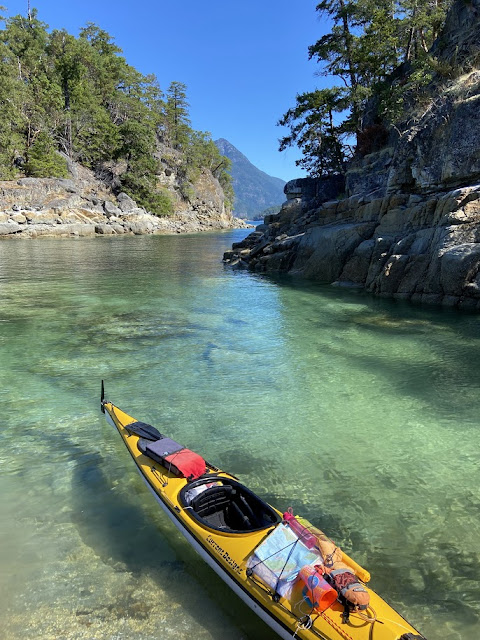
Another day, my friend and I were setting out to kayak, again on Okanagan Lake. We unloaded our boats from our vehicles and then carried our gear down and began strapping it to the hull. We each carry an extra paddle, a throw rope, a pump (to pump water out of the boat) and a paddle float. In the photo above, I'm also carrying a marine chart and a plastic cup to use as a bailer, because I discovered through practice that my arms tire pretty quickly using the pump to empty my boat. But those are items I add only for a longer, multi-day trip. 

While we were prepping our boats, a man stood by watching us. I noticed he had a slight grin on his face. When I met his eyes, he said, "You sure like to be prepared." His tone was gently mocking. I agreed that I did like to be prepared. He said "My friends I go out  paddleboarding in the Atlantic Ocean with just a cell phone for safety gear." The implication was we were wimps and he and his friends were not. I smiled and refrained from comment, but I was thinking that it sounded like the perfect opening for an adventure-gone-wrong movie. In the movie, the fit, cocky man out on the ocean on his paddleboard loses sight of his friends when the weather changes. He tries to call someone on his cellphone, but discovers he can't see the numbers through the fog on the plastic. So he tries to fish it out of its holder and he drops it into the (very) cold Atlantic Ocean. 

I don't want to leave my safety in someone else's hands. If I'm going on an adventure, I don't work Search and Rescue into my safety plan. That's a failed plan.

The paddleboarder's approach reminds me of something I've seen fairly often: a fear of looking stupid for being "over-prepared." Like people who don't wear helmets when riding or lifejackets when they're boating, some people seem to feel that taking steps to be prepared for things potentially going sideways is embarrassing. But which is really more embarrassing? To be the one who pulls out a mini air pump and a patch kit on a remote bike trail to help a stranger who gets a flat (as my spouse has done), or to be the one who makes someone else risk their own safety paddling out in high winds to tow them to shore?


Thursday, 2 June 2022

When I'm stuck


A rock and a hard place.
Some writing days, nothing much happens. I write a few sentences and scratch them out, get up and make a pot of tea, figure out a crossword clue, come back to the writing, write and cross out, write and cross out. If I have a string of days like this, I usually start to suspect that I'm going in the wrong direction.

Apparently, Warren Buffett has a box on his desk for investments that he considers "too hard." I use a similar filter for writing. If the writing is too hard, if a sentence or a plot isn't taking me somewhere, I back up and start again. But sometimes it takes me a while to notice.

When I was writing my second book, By the Secret Ladder: A Mother's Initiation, which is a memoir about the first year of new motherhood, I reached a point in the book where I was overcome with doubt. My editor had already warned me that expectant mothers might be scared by some of the story. I felt like if I told the truth, I'd be dooming the book to obscurity. But the dark part was the story. There was no way around that. I wrote, trying to ease into it, then I crossed it out. This went on for days. 

Finally, I realized that the path I was trying to take, softening the story, was too hard. And so I backed up and started again. Here's what I wrote:

Warning: This chapter is a little dark. If that bothers you, you could always skip it and go on to something with more light in it, more of what we associate with new mothers. You could choose to believe that becoming a mother is only about what you gain and never about loss. If you chose to believe that, you would have lots of company. 

I'm not supposed to be dark about this. I'm afraid of sounding ungrateful, afraid I've already screwed up my karma by unloading all my petty worries, and, as the books say, worry is bad for the baby. I worried about being worried.

After several days of unsatisfactory progress on my most recent novel, I realized that I'd set myself on a course I didn't want to follow. My characters were stuck in a cave (strangely metaphoric) and one person who is injured offers to give the other a boost to reach a potential exit overhead. But I discovered that I wasn't interested in writing that scene. This is how I got myself out of the corner I'd backed my writing self into:

A different stuck moment
"Let's try it," he said. "It's going to hurt but it's not going to kill me."

"Okay," I said. [Here's where I got stuck.]

But we didn't move. We sat there for another ten minutes or so while John Lee shifted, trying to get into a comfortable position, and groaned softly, trying not to. 

The conversation that followed did interest me and it got me back on a track where things are happening, the story is pulling me along. 

I pay attention to a physical feeling in my body when a story is deepening and beckoning to me. It's same kind of thrill I get from reading a good book. It's why I write.


Sunday, 13 December 2020

Low-tech: The long view

Snowy road near my house

As a reader, I'm sometimes jarred when I'm reading a novel and the technology the characters are using is slightly (or significantly) out of date. 

I confess that, in spite of having read several excellent novels lately with texting in them, I can't help feeling that five or so years from now, maybe fewer, that's going to seem quaint and a touch old-fashioned. 

It may be hard to believe that texting won't always be a thing, but once the telephone was seen that way. When I was a teenager, telephones -- the kind with dials, or maybe push-buttons if your family was a step ahead -- were the main way friends and I communicated. The fight for phone time in a crowded house, "party lines" where your neighbours could pick up the phone and listen in on your conversation, "extensions" in other rooms where your brother could pick up the phone and listen in on your conversation, that seemed like it was here to stay. So did record albums.

As a writer, I often face the question about what to do about technology in my novels. It's easy enough if I want the novel to be time-specific, like Shelter was -- set in the 1960s and 70s. But in Red Fox Road I wanted the time to be more or less now. That is, now, whenever now happens to be for the reader. That's why I go for the low-tech option, as much as possible. Unless it's important to the story, I want to keep the technology in the background.

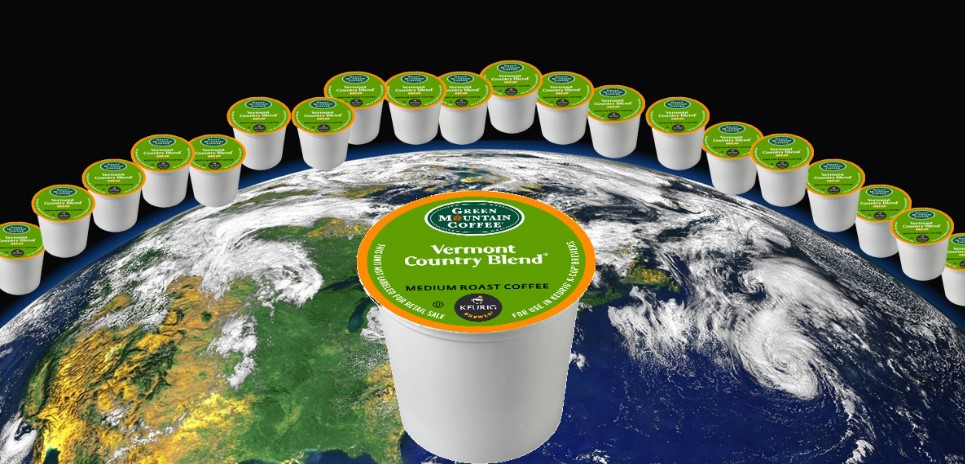
 The number of Keurig cups in landfills could circle the
 planet ten times. Don't get me started on tea K-cups!
Also, one of my themes in Red Fox Road and in the novel I'm working on now, Green Mountain Academy, is about the failure of technology. It's not that I'm anti-progress, or anti-innovation, quite the contrary. But I see, especially in the context of climate change, that we've used technology in many cases for cheap tricks, for junk that's literally messing up the planet. We could do so much better as humans. In Red Fox Road, Francie says "Not everything new that humans invent is better than the thing before it." Coincidentally, I agree with her! I think we need to be more responsible about how we use technology.

Getting out in nature, away from the noise of my various competing devices beeping, ringing, pinging and chastising me -- seeing the long view, literally, reminds me of how important it is.


Thursday, 5 November 2020

Don't side with yourself

Saturna island, BC

Stand firm. Don't back down. Stand up for what you believe in.  This was the kind of advice I heard when I was growing up. And to be sure, for a timid girl like me who was likely to back down whenever someone with a louder voice (which was just about anyone) spoke to me, it was helpful advice. I learned not to be a doormat and not to follow wherever someone else wanted to lead me.

But at some point -- maybe this point -- conviction and certainty begin to seem less useful than they once were. What would it be like to loosen my grip a little? 

"Don't side with yourself," said the 17th century Zen master, Bankei. I heard this expression the other day from Joseph Goldstein. It hit home. 

Maybe because the world is in a state of flux like I have never experienced in my lifetime. Maybe because the older I get, the closer I feel to the girl I was who found happiness sitting on a rock beside a little creek, counting the yellow leaves that drifted down from a cottonwood and landed softly on the water to be carried off gently down the stream. I didn't have to worry about being right or wrong. They are still my happiest moments.

I thought about the idea of not siding with myself this morning. Two days since the election in the US and the world is awash in side-taking. Opinions, fierce views -- what would it mean to let go, just a little, and see the other side? It's humbling to recognize how hard it is.
  

Saturday, 9 May 2020

A normal four a.m.

Full moon at 4 a.m.

Next weekend, BC is going to start relaxing isolation restrictions. We can gather in groups of six or less and maybe even hug each other. Or is that just family members in a closed group? I don't know. Meanwhile I have a fear that things are moving back to some kind of normal and I still haven't found what I'm looking for (to quote U2). Somehow I expected, if not enlightenment, at least illumination. Spring is here and the maple in the front yard is in lime green full leaf, casting shimmering patterns against brilliant blue. This morning I woke suddenly at 4 a.m. with a sense of urgency and I had to get out of bed and walk through the house, checking for -- what? That my son was where he should be, that everything was still where it should be. Everything was, except the full moon, which was shining in the pale early sky like it was still night. And I felt a longing to understand something, but that, too, was still where it's always been, just out of reach.

I'm not unhappy. I spend my days in the garden and feel very grateful to have these squares of dirt to dig and plant hopefully with beets and carrots and kale and arugula. Yesterday I transplanted tomatoes and bok choy and I took a ride on my bike and I felt like the day had been productive. Productive and relatively normal, but that's what feels wrong. Shouldn't it be extraordinary? Instead of washing my floors with a light solution of bleach and detergent while listening to Bruce Springsteen, shouldn't I be packing a few essentials and scaling a mountain I've never climbed to spend the night close to the stars and the moon and some kind of answers?

The experts say we'll have a "new normal," but in this new normal, will a dark-skinned man my son's age be able to run through his neighbourhood without fear? Will people in some of the richest countries in the world live in tents in a park in December and barter grocery cartloads of junk on sidewalks? Or will their new normal look suspiciously like the old normal? Will the most vulnerable among us still die before their time while others plan gardens and demand haircuts? Where is my part in this? I eat my avocado toast while hundreds of species continue to die out. Thousands sicken and some die so people can eat steak. Is this really the best new normal that the human race in the twenty-first century can manage? 

I cut tulips and sew face masks for my family. I believe I will come through this crisis relatively unscathed. I'm just not sure that's enough.

Monday, 4 May 2020

Isolation revelation

Saskatchewan prairie


I feel like there's a violin lodged in my ribcage.

My spouse has suggested it could be anxiety. Or maybe grief. Week six of The Covid isolation, as we've come to call this time, and he's sending me links to things to read about what I might be feeling. But none of these ring exactly true.

For a long time I've thought of myself as control-obsessed. I also know that I crave solitude. This morning, I realized how these two things go together. When I'm around other people, including and especially my beloved family members, I have an irresistible desire to meddle in their business. I'm going to blame this on being a writer, because it sounds better to suggest I'm driven by curiosity about the human condition than to admit that I'm just opinionated and bossy.

The Buddha said that "those who grasp after views and opinions wander about the world annoying people."  I first heard this from Jack Kornfield and I immediately identified with it. When I'm around others, I can't help but form opinions about the rightness or wrongness of their actions and their thinking, and to worry about it. Not only does this presumably annoy others, it sucks up the space in my soul where my peace and creativity reside. It is almost a physical occupation. I can feel it, like having too much caffeine -- a jumpiness of the heart, a jittery, fingers-in-too-many-pies feeling. And then I am overwhelmed by a desire to escape alone somewhere, preferably into the woods or down some lonely, windswept road. 

I think I now also understand why my spouse has always been so supportive of my retreats into solitude. It must also be exhausting for him that I, to put it nicely, care too much about what he's doing. Not exercising. Spending too much time at his computer. Not getting enough fresh air. Why can't I mind my own business? 

And yet when I do get away on my own, my ability to not care is profound. I care only about that birdsong that I always thought was a chickadee. Is it? The way the shadows fall in the afternoon. Where exactly the moon will rise. How long my tea has steeped.

Of course I only had this revelation this morning when my beloved and son left for Vancouver to empty son's apartment for month-end. The house is quiet and peaceful and the long, quiet day stretches before me. I feel the calm returning to my ribcage by slow degrees. I am resisting the urge to meddle in their business digitally. (When I began a text using the word "emptying", my phone helpfully supplied the word "soul" as the next word.)

I'm aware of how ungrateful this might sound, given that, around the world, people are suffering real loneliness in their isolation. But I can't be the only one having trouble coping with the opposite. Can I?

So I've decided to begin each morning with a simple vow: not to meddle in anyone's business today. My new mantra will be "It's your call." (I will try to mean it generously, with true goodwill and no hands-thrown-in-the-air undertones).  Wish me luck. This won't be easy for me.